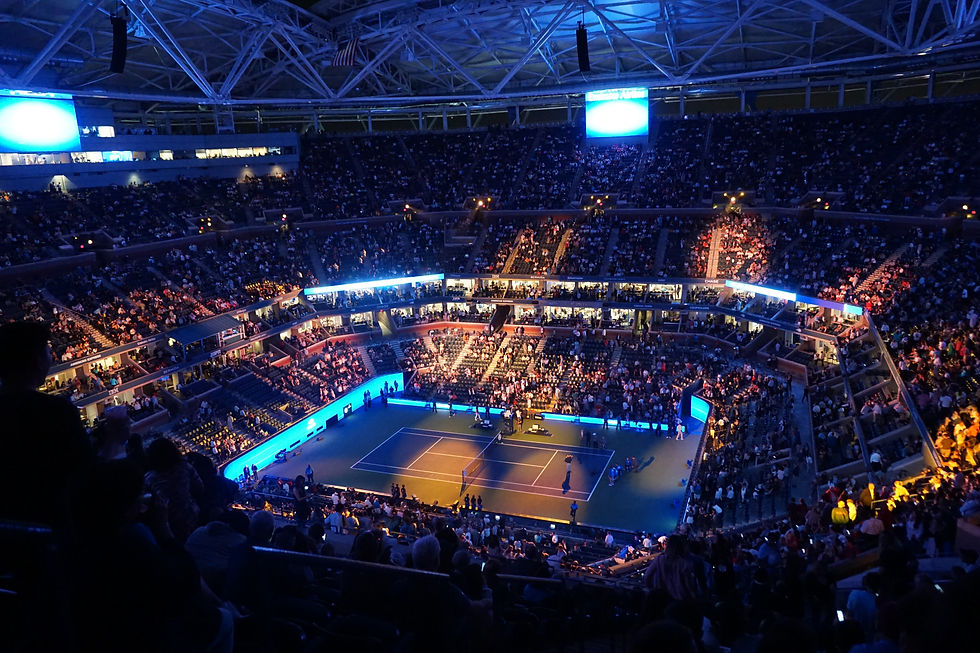
US Open Finals Weekend Private Transportation: Plan the Return Before You Arrive

Updated: Oct 6
US Open finals weekend private transportation should be designed backward.
The instinct is to plan the arrival first: hotel pickup, desired entrance time, vehicle, guest list and perhaps a lunch or hospitality reservation before Arthur Ashe Stadium.
For the final weekend, the more difficult operational question is usually what happens after the last ball.
The official 2026 US Open schedule places the women’s singles final on Saturday, September 12, with the men’s final on Sunday, September 13 as part of Championship Week. The USTA lists the September 12 and 13 day-session gates opening at 11:00 AM and notes that session dates, starting times and gate times remain subject to change.
That uncertainty is not a planning defect. It is part of live sport.
A match may move quickly. It may become a five-set epic. A guest may stay for hospitality afterward, meet friends inside the grounds, leave early, or decide that dinner plans should change. Thousands of other attendees are making their own departures at roughly the same time.
For private clients, executive hosts, assistants and families, the transportation plan should therefore answer one question before the day begins:
How do we want the return to work when nobody can know the exact release time?
Official schedule information: US Open Ticket Plans Official gate information: 2026 US Open Gate Opening Times
Table of Contents
Why US Open Finals Weekend Private Transportation Is a Departure Problem
Build the Return Around Release Windows, Not a Predicted Match End
A Better Question for Executive Assistants: What Must Happen After the Match?
Hosting Clients at the US Open: Protect the Guest Experience After the Final
The Most Expensive Mistake Is Not a Higher Transportation Rate
Why “We’ll Figure Out the Return Later” Is Usually the Wrong Approach
US Open Finals Weekend Private Transportation With VIP NYC Transfers

Why US Open Finals Weekend Private Transportation Is a Departure Problem
Most event transportation is sold as an arrival product.
That is understandable. The arrival is visible. The vehicle pulls up, guests step out, the chauffeur assists, and the experience begins.
The departure is less photogenic and more consequential.
After a major final, guests may be:
leaving at different times;
tired after a long day;
separating from a larger hosted group;
carrying purchases or personal belongings;
trying to make a dinner;
returning to different hotels;
continuing to a private event;
departing for an airport;
communicating from a crowded environment.
At the same time, the chauffeur cannot simply assume unrestricted access to the closest possible curb or gate.
Traffic direction, official venue operations, security conditions and event-specific instructions govern how vehicles approach, stage and reconnect with guests.
The result is simple: a high-quality arrival does not guarantee a high-quality return.
The return must be planned independently.
Championship Week Has a Different Rhythm
The official US Open Championship Week package covers September 8–13, 2026, including quarterfinals, semifinals and finals at Arthur Ashe Stadium.
By the final weekend, the schedule narrows. There are fewer headline matches, higher concentration around Arthur Ashe and a different type of guest behavior.
Many attendees are not simply coming for tennis. They may be entertaining clients, hosting family, meeting friends, using hospitality areas or treating the final as the centerpiece of a larger New York weekend.
That changes what “on time” means.
For an ordinary appointment, a guest may want to leave at 6:00 PM.
After a final, “6:00 PM” may mean:
the match just ended;
the guest is still inside;
the guest is leaving hospitality;
the guest is waiting for another member of the party;
the guest has decided to stay longer;
the guest is ready immediately.
A transportation structure that depends on one precise release minute is therefore fragile by design.
The Three Return Models That Matter Most
1. Dedicated chauffeur standby
For finals weekend, dedicated service is often the cleanest structure when continuity matters.
The assigned vehicle and chauffeur remain attached to the client’s day according to the confirmed terms of service.
This can be especially appropriate when:
the release time is uncertain;
belongings remain with the vehicle;
the principal is hosting guests;
the group may change plans after the match;
dinner or another commitment follows;
the client wants one communication thread throughout the day.
The value of standby is not simply waiting.
It is removing the need to recreate the transportation arrangement precisely when the environment is most congested and the guest has the least interest in doing so.

2. Two separate point-to-point transfers
Separate outbound and return transfers can be entirely appropriate when the itinerary is simple and the client is comfortable reconnecting with a separately scheduled vehicle after the match.
This structure may suit:
a small party;
no luggage or belongings left in the vehicle;
a clear post-match destination;
a guest comfortable with a designated return coordination process;
a schedule with reasonable tolerance.
The important point is to avoid pretending that the match will end at an exact minute.
The return should be structured around the operator’s event plan, the official pickup environment and a realistic communication method rather than a guessed final-whistle equivalent.
3. Multi-vehicle hosted coverage
Executive hosts and private families sometimes arrive together but do not leave together.
One couple may depart early. A principal may remain for hospitality. A guest may return to a different hotel. An assistant may need to leave before the hosted party.
If that possibility is known in advance, the transportation plan should not force everyone into one vehicle simply because they share the same tickets.
Two vehicles can sometimes be less complicated than one.
The correct structure depends on the guest hierarchy, passenger count, belongings, planned destinations and likelihood of separation.
Comparison Matrix: Finals Weekend Transportation Structures
Planning need | VIP NYC Transfers | Separate generic bookings | Ad hoc app-based transportation | Hotel-arranged vehicle |
|---|---|---|---|---|
Match-duration uncertainty | Can be built into the service structure | Requires return coordination | Reactive | Depends on availability |
Dedicated chauffeur continuity | Available when reserved as dedicated service | Not inherent | No | Usually no |
Executive assistant as primary coordinator | Supported | Must coordinate each booking | Usually passenger-led | Varies |
Multiple post-match destinations | Can be planned in advance | Requires additional bookings | Reactive | Reactive |
Belongings remaining with vehicle | Can be addressed where appropriate and confirmed | No continuity assumption | No | Varies |
Hosted guest separation | Can be structured before service | Fragmented | Reactive | Reactive |
Airport after the final | Can be incorporated into the itinerary | Separate booking | Separate booking | Separate request |
Vehicle chosen around party and luggage profile | Reviewed before assignment | Varies | Platform-dependent | Availability-dependent |
Escalation and concierge oversight | Defined communication layer | Provider-specific | Platform workflow | Hotel desk workflow |
Discretion | Core operating standard | Provider-dependent | Variable | Provider-dependent |
The correct question is not which option appears most premium.
It is which option creates the fewest operational dependencies for the actual party.
Build the Return Around Release Windows, Not a Predicted Match End
A useful event-planning framework is to think in terms of release windows.
Early release
The guest decides to leave before the match concludes.
This can happen for a flight, dinner, a child’s schedule, fatigue or simply preference.
The chauffeur-services structure should make it clear how the guest signals an early departure and where the reconnection will occur under the operating conditions of the day.
Expected release
The guest leaves at the natural conclusion of the match and normal post-match activity.
This is the most common scenario and also the point at which surrounding departure demand is likely to be concentrated.
The plan should assume that curbside simplicity may be lower than it was on arrival.
Extended release
The guest remains for hospitality, socializing, a post-match event or another reason.
A retained vehicle can absorb this more naturally than a rigidly timed point-to-point structure, although any service remains subject to the agreed reservation terms and duty parameters.
The key is not to predict which release will happen.
The key is to decide in advance how each release would be handled.
A Better Question for Executive Assistants: What Must Happen After the Match?
If you support a principal attending the women’s or men’s final, begin with the commitment after Arthur Ashe.
There are four common cases.
Case 1: Nothing is fixed afterward
This is the easiest scenario.
The return can prioritize guest comfort and flexibility. A dedicated vehicle may still be desirable, but there is no downstream appointment forcing a hard departure.
Case 2: Dinner is fixed
Now the final has a downstream consequence.
The assistant should identify the latest reasonable stadium release that still protects the dinner, accounting for post-event movement and the conditions expected on the service date.
If the match runs beyond that threshold, the principal may need to make a choice.
Transportation cannot eliminate that tradeoff, but it can make the decision visible early enough to be useful.
Case 3: Airport departure follows
This is a materially different risk profile.
An airport departure should govern the day. The exact planning margin depends on the airport, flight, terminal, baggage, traveler profile, international or domestic routing, airline requirements and current traffic conditions.
A tennis final should never be allowed to quietly consume the time allocated to an immovable flight.
The assistant and transportation team should establish an airport trigger time before service.
Case 4: Hosted guests have different destinations
The host may return to one hotel while guests return elsewhere.
If this is known in advance, vehicle allocation should reflect it.
The host should not need to decide at the stadium exit whether the principal’s vehicle becomes a distribution vehicle for the entire guest list.

Vehicle Selection for Finals Weekend
Vehicle selection should remain practical.
Cadillac Escalade ESV
The Escalade ESV is often appropriate for private families, executives and small hosted parties requiring generous cabin space and useful luggage capacity.
For finals weekend, the combination of comfort and flexibility can be particularly helpful if the day includes hotel movements, shopping, hospitality or airport luggage.
Maybach S-Class
The Maybach S-Class may be appropriate for a principal or couple prioritizing rear-cabin comfort, privacy and a formal executive environment.
Its passenger and luggage limits should be reviewed against the full day, not only the stadium transfer.
Executive Sprinter
An executive Sprinter can be appropriate for a larger hosted group that intends to remain together.
It becomes less attractive when several guests are likely to leave separately or return to materially different destinations.
A larger vehicle solves capacity. It does not solve passenger divergence.
The Arrival Still Matters — But It Should Be Simpler
Finals weekend arrivals should be designed with enough margin to preserve the experience without turning the day into an exercise in over-buffering.
The USTA publishes official gate opening times and notes that schedules can change.
Guests should use current official event information to decide when they want to be inside the grounds, then work backward from that target.
The transportation brief should include:
hotel, residence or other pickup point;
session and ticket information;
desired venue-ready time;
passenger count;
mobility considerations;
vehicle preference;
belongings;
hospitality plans;
post-match destination;
primary coordinator.
The arrival should be calm.
The departure should be deliberate.
Hosting Clients at the US Open: Protect the Guest Experience After the Final
For corporate and executive hosts, the transportation experience is part of the hospitality.
A guest should not need to hear a discussion about where the vehicle is, who booked the return, whether another vehicle is coming, or which person is responsible for the second hotel.
That coordination should happen elsewhere.
A well-prepared host or executive assistant can create a simple guest-facing experience:
one person is the transportation contact;
guests know whether they are traveling together;
any separate departures are already identified;
the chauffeur is briefed on the authorized communication structure;
the post-match destination is understood;
changes are handled through the coordinator.
The guest receives the outcome, not the logistics.
That is an important distinction in premium hospitality.
Family Finals Weekend: Comfort Means Fewer Decisions
For families, finals weekend can be a long day even when everything goes well.
Children may tire. Older family members may need a more controlled pace. A guest may want to leave early. Shopping bags and personal items accumulate. Restaurant plans change.
The transportation plan should reduce the number of decisions the family needs to make after the match.
Useful questions include:
Could anyone reasonably want to leave early?
Are children or older guests involved?
Are child restraints or mobility accommodations required?
Will belongings remain with the vehicle?
Is everyone returning to the same destination?
Is dinner fixed?
Is a second vehicle worth planning before it becomes necessary?
These questions are not about overengineering the day.
They are about protecting the family from predictable friction.
The Most Expensive Mistake Is Not a Higher Transportation Rate
For high-value travelers, the most expensive transportation mistake is often not paying more for the service.
It is allowing a low-probability logistics failure to disrupt something more valuable.
A missed dinner with an important client.
A principal waiting outside after a final.
A family split without a clear plan.
A flight placed under unnecessary pressure.
An assistant forced into repeated calls while managing the principal.
A host ending an exceptional day with visible confusion.
The purpose of premium private transportation is not extravagance.
It is control proportionate to the importance of the itinerary.

Why “We’ll Figure Out the Return Later” Is Usually the Wrong Approach
The return is precisely the part of the day that is hardest to improvise.
By the time the match ends:
the guest is focused on leaving;
thousands of other people are doing the same;
the environment is louder;
schedules may have changed;
phone batteries may be lower;
the group may be less organized than at departure;
the guest may have little patience for logistics.
Planning the return earlier costs almost nothing.
Planning it at release costs attention at the exact moment attention is scarce.
The most elegant event transportation plans therefore decide the return logic before the guest enters the venue.
US Open Finals Weekend Private Transportation With VIP NYC Transfers
VIP NYC Transfers provides discreet event arrivals and departures for private families, executives, executive assistants, chiefs of staff, event hosts and other travelers requiring reliable transportation across New York City and the surrounding region.
For US Open finals weekend, the appropriate structure may include point-to-point transportation, dedicated hourly service, executive SUVs, Maybach service, executive Sprinters, airport transfers or coordinated multi-vehicle coverage, subject to availability and the confirmed itinerary.
The objective is straightforward:
Arrive composed.
Enjoy the match.
Leave without turning the end of the day into a logistics exercise.
That is why the return should be planned before the arrival.
Frequently Asked Questions
When is US Open finals weekend in 2026?
The official US Open schedule places Championship Week from September 8–13, 2026. The women’s singles final is scheduled for Saturday, September 12, with the men’s final on Sunday, September 13. Official schedules remain subject to change.
What time do the gates open for the 2026 US Open finals?
The USTA currently lists gates opening at 11:00 AM on Saturday, September 12 and Sunday, September 13. Guests should reconfirm the official schedule before attending.
Is dedicated chauffeur standby better for the US Open final?
It can be when the match release is uncertain, belongings remain with the vehicle, guests may separate, dinner follows, or the client wants one continuous transportation assignment. Separate point-to-point transfers may be sufficient for a simpler itinerary.
Can VIP NYC Transfers guarantee pickup at the closest stadium gate?
No such assumption should be made. Official venue operations, traffic control, security conditions and event-specific instructions determine where vehicles may approach, stage and collect guests.
Which vehicle is best for US Open finals weekend?
The right vehicle depends on passenger count, luggage, mobility requirements, desired cabin experience and whether the party will remain together. An Escalade ESV, Maybach S-Class, executive Sprinter or another configuration may be appropriate after the complete itinerary is reviewed.
Can VIP NYC Transfers coordinate the US Open final with an airport departure?
Yes, subject to availability and the specific itinerary. An airport departure should be treated as a fixed downstream constraint, and the service plan should be designed backward from the required airport timing.
What if some guests want to leave before the match ends?
That possibility should be discussed before service. Depending on the party structure, one dedicated vehicle may still work, or a second vehicle may be more appropriate if the host and guests are likely to separate.
What information should I provide when requesting finals weekend transportation?
Provide the date, session, pickup point, desired venue-ready time, passenger count, post-match destination, dinner or airport commitments, luggage or belongings, vehicle preference, likely guest separations and the primary coordinator’s contact details.