Randall's Island Private Transportation: Icahn Stadium, Event Access and Guest Collection

Randall's Island private transportation is not simply a Manhattan address entered into a navigation system. The island hosts athletic competitions, park programs, concerts and private events whose arrival and collection instructions can differ considerably. A vehicle can legally reach the island yet still lack permission to stop at a particular event entrance. An address is not a vehicle-access authorization.
For an executive assistant, event coordinator or private household, the essential decision is how the guest travels from the RFK Triborough Bridge approach to an actual permitted handoff. This guide separates published park rules from event-specific instructions and explains what should be verified before assigning a chauffeur, arranging a second guest vehicle or promising an end-of-event collection.
Table of Contents
Randall's Island private transportation: first identify the real destination
The Randall's Island Park Alliance directions identify 10 Central Road, New York, NY 10035, as a GPS destination for Icahn Stadium. That address should not automatically become the destination for every festival, athletic field or privately managed function across the park. A coordinator needs the actual facility name, gate and the host who is authorized to explain event admission.
The Alliance describes Icahn Stadium as a multiuse venue serving track events and other programs. Different organizers can establish different arrival times, screening arrangements and parking procedures for different functions at the same facility. A previous guest's smooth entrance therefore does not prove that the same route or positioning will be permitted during another event.
Before confirming the itinerary, obtain the invitation or organizer's event notice, full venue designation, guest entrance, credentialing procedure and contact for an access change. If the organizer has not identified a gate, mark that information unverified rather than asking the chauffeur to choose one from public mapping software.
The RFK Triborough Bridge is the vehicular gateway
According to the park operator, all vehicular access to Randall's Island is through the RFK Triborough Bridge. Reaching a bridge approach is not the same as arriving at Icahn Stadium or a private event gate. The distinction matters when the first appointment is a fixed call time rather than a flexible afternoon activity.
A Manhattan departure must be planned against the real service date, including approach traffic, on-island circulation and any temporary event controls. Navigation may suggest a preferred bridge approach, but that recommendation can change as road conditions develop. An assistant should not apply a standardized Midtown-to-island journey time across all programs without current evidence.
The Alliance also cautions that RFK bridge renovation activity can affect traffic patterns on the island. Protect the fixed commitment and verify the last approach, especially when the guest must arrive ahead of general admission for a speech, reception, athletics registration or production briefing. An artificially precise travel-time promise would be less useful than a clear last-mile decision.
The published parking rules do not guarantee private collection
Randall's Island has limited parking, according to the park operator. Cars must use designated parking areas; vehicles left outside them may be ticketed. Major concerts and festivals may charge for parking even where another day's designated-area parking is free. These facts describe public parking policy, not a universal reserved waiting location for chauffeur services.
A guest who requires collection directly after a program raises several distinct questions. May the chauffeur drive to the authorized entrance? May the vehicle stop briefly? Can it remain parked while the event proceeds? Can it return after the program, when crowd controls may be different? One permitted movement does not establish the next permission.
An organizer might allow advance-registered vehicles into one area yet direct ordinary traffic elsewhere. Another event might have a designated departure collection procedure or off-island staging requirement. Those rules are controlled by the organizer and relevant authorities. Only current, specific instructions justify saying that an access plan is confirmed.
Icahn Stadium: do not generalize the large-bus instruction
The Icahn Stadium operator guidance instructs large buses to drop off groups at the stadium bus stop, then use Lots D, E or F for parking, with a walk to Icahn Plaza. This is a motor-coach or large-bus procedure. It is not evidence that an individual sedan, Escalade or executive Sprinter can wait there or take the same route.
For an Executive Sprinter or another larger vehicle, verify how the event treats the specific vehicle category and what the operator's policy permits. An executive interior configuration does not override a size, traffic or loading restriction. The distinction must be confirmed rather than resolved by choosing whichever vehicle category sounds more convenient.
Where a group is using a larger vehicle, the event organizer should identify who receives the passengers at the approved drop-off and whether anyone needs assistance with the last pedestrian segment. A bus stop is an operational handoff, not necessarily the door at which the group presents credentials.
Four separate decisions define the assignment
The first decision is whether a vehicle can enter the permitted event zone. The second is whether it may unload the guest at an approved point. The third is whether an appropriate legal waiting location is available. The fourth is the end-of-event pickup procedure. A plan can pass the first two and still fail the last two.
An executive assistant should record each decision as confirmed, conditional or unknown, with the date and source of the instruction. Record the guest's arrival window separately from the desired vehicle position. If security may redirect traffic, specify who will provide the updated location and how the guest is expected to receive it.
For the guest, an instruction such as “meet the vehicle at the venue” is not precise enough when different lots and internal roadways exist. Use one named, permitted point and one contingency channel. One authoritative instruction should reach both the chauffeur and the guest.
The arrival brief should protect the real appointment
A useful service brief begins with the event date, exact destination and the first fixed commitment: a stadium check-in, private reception, speaker preparation or access credential pickup. The published event start may be substantially later than the guest's actual required presence.
Include the number of travelers, planned luggage or equipment, vehicle constraints, any mobility assistance requirements the guest voluntarily communicates, the authorized arrival contact and which person can resolve an admission issue. Do not circulate personal travel details to a group that does not need them.
If several attendees come from different hotels, identify which must arrive first. Combining a principal with fixed obligations and companions with flexible departures creates a shared dependency. Separate vehicle assignments may be more resilient, if available, while a consolidated arrangement may be entirely appropriate when the times genuinely align.
Guest readiness matters more than the nominal program end
After a concert, gala or sporting event, the published finish may not equal the time the guest is ready to leave. The principal may meet the host, return to a reception or wait for colleagues. Ask which coordinator is authorized to declare that the guest is leaving the venue.
A strong collection sequence has three states: the program has ended; the guest is moving toward the correct exit; and the guest is physically ready at the agreed handoff. The chauffeur should not be asked to occupy an unpermitted curb for an indeterminate period while these states are treated as identical.
If the guest's release is unpredictable, retained chauffeur availability can be useful, but retained service does not guarantee waiting inside the event perimeter. Confirm a lawful position and a realistic mechanism for returning to the collection point when the guest is ready.
Ferry or pedestrian access is a separate transport system
The Park Alliance identifies pedestrian access via the 103rd Street Footbridge and bridge walkways, along with ordinary transit options. It also notes ferry operations in conjunction with certain major events. No article should imply that a ferry is running for every private party, stadium competition or concert.
A party traveling by ferry or walking onto the island requires a different handoff than one whose authorized vehicle arrives through the RFK bridge. The coordinator must establish which party is responsible for the ticketed ferry, its operating schedule and the pedestrian segment; those elements are not included automatically in a chauffeur booking.
If the group is using a mainland staging point, record that location distinctly from the island destination and avoid treating them as the same address. A vehicle cannot simply cross the water to correct a missed ferry departure or a change in event access instructions.
When crowd control changes the collection point
A large gathering can change vehicle circulation during departure. An organizer may use barriers, marshals or directions not visible in the advance notice. Chauffeurs must follow actual lawful instructions rather than assuming that a pre-event route remains open after guests depart.
When the planned exit is closed or the chauffeur cannot approach, the coordinator should identify an authorized alternative and explain any pedestrian segment. A guest should not be encouraged to cross uncontrolled traffic, seek out a stopped vehicle in an active lane or abandon a safe event-managed route for convenience.
A practical decision matrix for Randall's Island event transportation
The comparison below is a decision instrument, not a list of permissions granted by the park. Each row distinguishes publicly available operational facts from confirmation that must come from the specific organizer or responsible authority. It is useful for assistant and dispatcher review before the client is given final instructions.
Event condition | Verified instruction needed | Coordinator's decision | What the guest should know |
Icahn Stadium is the confirmed venue | Exact organizer-approved entrance and credential rules | Protect check-in and legal unload point | Attend the named entrance, not a guessed gate |
Only 10 Central Road is supplied | Facility and event gate still missing | Hold final drop-off directions | GPS address alone is insufficient |
Large motor coach is assigned | Park operator's stadium bus-stop drop-off and Lots D/E/F parking rules; organizer-specific event confirmation | Apply the published large-bus instruction only to the relevant motor-coach category | Expect the stated pedestrian segment to Icahn Plaza |
Executive Sprinter or SUV is assigned | Specific event instructions for that vehicle class, permitted drop-off and any separate waiting position | Do not infer permission from the motor-coach rule or the 10 Central Road GPS address | Use the organizer-approved handoff and a confirmed alternative if redirected |
Departure time is uncertain | Permitted standby plan and release contact | Consider retention without assuming on-site waiting | Wait for one confirmed pickup message |
Security redirects the planned exit | Current lawful alternative and pedestrian approach | Reposition after confirmed update | Do not approach a stopped vehicle in traffic |
Point-to-point versus retained chauffeur service
A simple competition with a known return window and no extra commitments may suit separate arrival and departure assignments. A principal whose program end time is uncertain or who may change destination has stronger reasons to retain a dedicated chauffeur, subject to actual availability and lawful staging.
Where a guest carries equipment or documents, decide who controls those belongings while the event is in progress. Retaining a vehicle can simplify continuity, but only when the transportation operator can actually manage the associated wait, security and custody arrangements. Do not imply that stadium staff will safeguard property on the operator's behalf.
This is a choice about uncertainty and control, not a prestige ranking. VIP NYC Transfers' corporate event transportation coordination can be considered for the private-transport portion of a real itinerary; the event organizer still owns the event-specific access permission.
An example: three guests, one fixed speaker arrival
Imagine three guests attending the same stadium program, leaving different Manhattan hotels. One must report for a speaker briefing before the others need to arrive. Combining all three arrivals might reduce the number of vehicles but creates a risk that a late companion delays the speaker.
If the appointment is genuinely fixed, protect it separately or set a meeting point and departure rule that do not depend on the flexible guests. The decision should be based on actual schedule compatibility, luggage fit and permitted handoffs, not just the convenience of filling every seat.
The assistant should also confirm which guest holds the credentials and whether the host expects the group together. Private transportation cannot substitute for missing admission authorization. The point at which the chauffeur finishes a legal drop-off is not necessarily the point at which the event recognizes the guest as checked in.
Accessibility and private household considerations
An event-approved vehicle handoff does not by itself prove that the remaining path is step-free or appropriate for a guest's mobility needs. Temporary barriers, interior venue routes and large-bus arrangements can change the last portion of the journey.
Randall's Island Park Alliance publishes inconsistent guidance about pedestrian accessibility. Its general information page describes the Manhattan and Bronx RFK Bridge walkways as ADA-accessible, while another official directions page says that ramps on those approaches exceed ADA code. Both describe stairs on the Queens approach, which is not ADA-accessible. Do not assume that any bridge approach or the remaining vehicle-to-stadium segment meets a guest's mobility needs. Confirm a current accessible route, the approved event entrance, and the permitted vehicle handoff directly with the park or organizer before finalizing the itinerary.
For private families, confirm children and accompanying adults are accounted for during both entry and collection. A driver should not be tasked with deciding whether a child may leave a venue with a particular adult; agree the responsible guest contact and authorized transfer procedure before the event.
A discreet and executable request
A booking inquiry can begin with the date, exact event and facility, the principal's first fixed commitment, the number of travelers, preferred vehicle class and return expectations. The most important supporting item is any organizer-supplied gate, parking or collection notice. If that document is not yet available, identify the access portion as pending.
No credible service description should promise an unrestricted private lane, permanent stadium parking, a fixed bridge journey time or guaranteed collection directly outside a door. The useful promise is professional coordination around what is known and disciplined communication when instructions change.
VIP NYC Transfers can review the itinerary and discuss appropriate private transportation and concierge coordination. The planning standard remains clear: confirmed venue instructions, a lawful vehicle position, a named release contact and a fallback that guests can follow without confusion.
Frequently asked questions
How can a chauffeur reach Randall's Island?
The Park Alliance says vehicular access is via the RFK Triborough Bridge. Access to a particular event gate must still be confirmed.
Does 10 Central Road identify every Randall's Island venue?
No. The Park Alliance provides 10 Central Road as the GPS address for Icahn Stadium, not as a universal entrance for every island event.
Can a private vehicle wait at Icahn Stadium?
Designated parking exists, but availability, fees and permission to wait can depend on the event and vehicle category. Confirm the applicable rules before booking retained standby.
What are the stadium's motor-coach instructions?
The operator directs large buses to the stadium bus stop for drop-off and then designated Lots D, E and F. This is not automatically the rule for private passenger vehicles.
Is retained chauffeur availability helpful after a concert?
It may be appropriate if the departure time is uncertain and a lawful standby and collection plan is possible. Retention does not provide permission to remain in an event-controlled zone.
Editorial responsibility and source notes
Prepared by the VIP NYC Transfers Editorial Team. This source-checked planning guide separates published park information from permissions that must be confirmed for a specific event. Reviewed October 15, 2026; venue instructions may change.
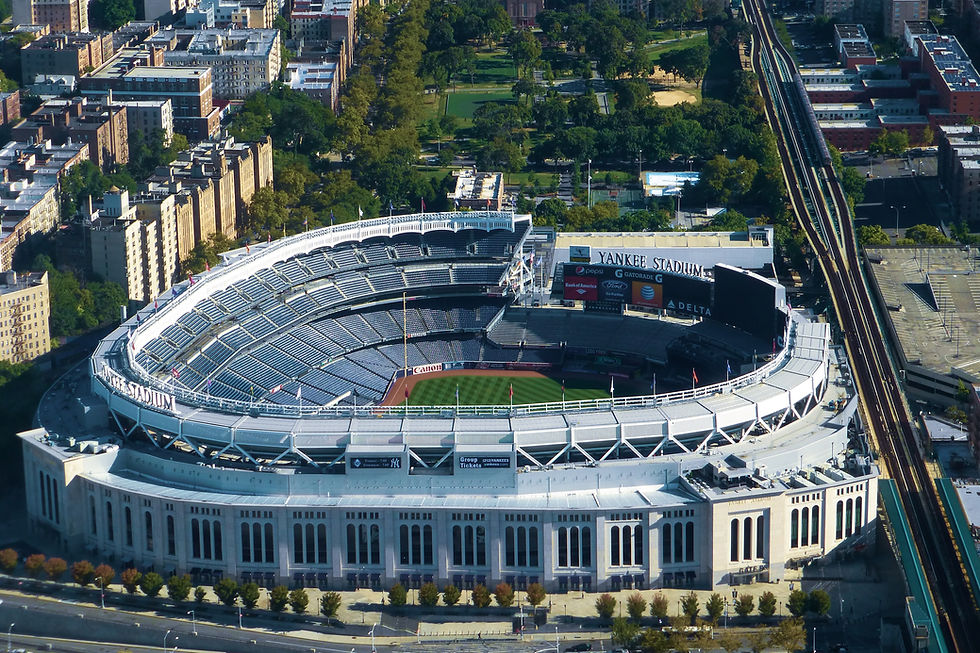
Historic venue photograph, Tom Paliswiat (2005), CC BY 3.0. Used unmodified as an illustrative historic photograph; not evidence of current event access.