US Open Evening Chauffeur Service in NYC: The Executive Standard for a Complete Night

Updated: Oct 6
For a senior executive, a US Open evening chauffeur service rarely begins at the gates of the USTA Billie Jean King National Tennis Center. It may begin in a Midtown office, after a final meeting on Madison Avenue, at a hotel where a client is waiting downstairs, or at a residence where the principal has only minutes to change pace. That is why choosing private transportation for the evening is not simply a transportation decision. It is a decision about how the evening will feel before the first point is played.
The critical transition is psychological as much as logistical. An executive can leave a full day of calls, negotiations, board discussions, or client obligations carrying the tempo of the office into the evening. Poorly designed transportation preserves that pressure: messages continue, guests wait, timing feels compressed, and the principal arrives already managing the next problem. A better plan creates a controlled interval between work and hospitality—private enough to reset, structured enough to remove minor decisions, and flexible enough to keep the evening coherent.
For executives reserving chauffeur services in NYC, the standard should therefore be judged across the complete evening rather than by the vehicle alone. The most useful question is not simply, “How do we get to the US Open?” It is: what transportation structure allows the principal to move from business intensity to social presence without carrying unnecessary operational friction into the night?
There is also a reputational dimension that is particular to executive hospitality. When a principal invites a client, investor, colleague, or senior partner to the US Open, the evening becomes part of the relationship environment. The guest will not necessarily remember the mechanics of the transportation, but he or she will notice whether the host appears distracted by them. The operational standard is therefore measured by how little attention the evening requires from the executive once it has begun.
Table of Contents

The US Open Evening Begins Before the Chauffeur Arrives
An executive evening has a pre-departure phase that is easy to ignore. Meetings run close to the planned departure. A guest may be arriving from another hotel. An assistant may still be confirming tickets or dinner. The principal may need ten quiet minutes before joining others. None of these details is dramatic, yet together they determine whether the departure feels composed or compressed.
This is why the pickup time should not be treated as the beginning of the plan. The real planning point is the executive’s release from the business day. A chauffeur positioned appropriately can support that release, but only if the coordination structure recognizes that “ready at 5:30” and “free from obligations at 5:30” are not the same thing. An outstanding evening protects the transition window rather than consuming it.
For a principal leaving Midtown, Hudson Yards, Wall Street, the Upper East Side, or a major Manhattan hotel, that distinction changes the service design. The executive office should consider where the final business obligation ends, where guests will join, whether the principal needs privacy before conversation resumes, and whether the group should assemble before or after departure. The objective is not to add ceremony. It is to prevent the first hour of the evening from becoming an extension of the workday.
This creates a useful test for assistants and chiefs of staff: if the principal must repeatedly ask where the vehicle is, when to leave, who has been contacted, or what happens after the match, the service design has transferred coordination back to the person it was meant to support. A stronger plan gives the executive office a defined communication path before departure and allows the principal to participate in the evening rather than supervise it.
The Executive Evening Continuity Model
A useful way to evaluate US Open evening chauffeur service is through four consecutive phases: Release, Reset, Reception, and Return. The value of the model is that it treats transportation as a continuity question. Each phase has a different purpose, and a weak decision in one phase tends to surface later as visible friction.
Release concerns the handoff from the day’s obligations to the evening. Reset is the private interval in which the principal can finish a call, review a message, change conversational mode, or simply disengage. Reception begins when guests are together and the executive becomes host, colleague, or companion rather than operator. Return is the closing movement, when energy is lower and the appetite for additional decisions is usually at its lowest.
The model is intentionally different from a timetable. A timetable asks when each movement occurs. The continuity model asks what each movement must accomplish for the executive. That distinction is especially relevant for an evening sporting engagement because the social value of the night often lies between formal moments: the conversation before arrival, the privacy between obligations, the shared anticipation before the match, and the calm conclusion after a crowded venue experience. Transportation should support those transitions without becoming the subject of them.
For the executive office, the model also provides a practical decision sequence:
Release: Identify the true end of the principal’s working commitments.
Reset: Decide whether privacy or guest interaction should define the first portion of the journey.
Reception: Determine when the principal should move into host mode and who should be present.
Return: Establish the likely conclusion of the evening before fatigue or changing plans make small decisions unnecessarily cumbersome.
This is not overengineering. It is a way to make fewer decisions during the evening by making the right ones beforehand.
Why the Vehicle Is a Working Environment Before It Is an Amenity
For executives, the interior of the vehicle may be the only controlled environment between the office and the stadium. That makes comfort consequential in a more specific way than simply having a refined cabin. The principal may need to take a confidential call, review a final note, sit quietly after a demanding day, or speak privately with a colleague before joining a broader group.
This is where vehicle selection should follow the evening’s behavioral requirements. A larger SUV may be appropriate when several executives or guests are traveling together, while a sedan may better suit a principal who values a quieter individual transition. Group size, luggage, seating preferences, and the possibility of additional guests should be confirmed before reserving. The correct vehicle is the one that preserves the intended social and working dynamic, not the one chosen merely for appearance.
The same logic applies to guest composition. If an executive is hosting a client, the private interval before arrival may be commercially meaningful. If the principal is attending with peers, the vehicle may become the first room of the evening. If the executive is traveling alone after a long day, the absence of conversation may be the luxury that matters most. These are small distinctions operationally, but they determine whether the transportation feels intelligently matched to the person using it.
There is another reason this distinction matters. Executives frequently spend their days moving between environments designed by other people: conference rooms, offices, restaurants, hotels, event spaces, airports. The vehicle can be one of the few environments where the executive office has meaningful control over who is present, how much conversation occurs, and whether the principal has an uninterrupted interval. That controlled space has value precisely because the rest of the evening is public.
For that reason, vehicle choice should follow questions such as:
Will the principal need confidential conversation before arrival?
Should invited guests travel with the principal or meet separately?
Is a quiet individual transition more valuable than keeping the group together?
Will the same vehicle environment remain appropriate after several hours at the tournament?
These questions are more useful than beginning with badge, body style, or appearance alone.
Arrival Should Preserve Social Momentum, Not Interrupt It
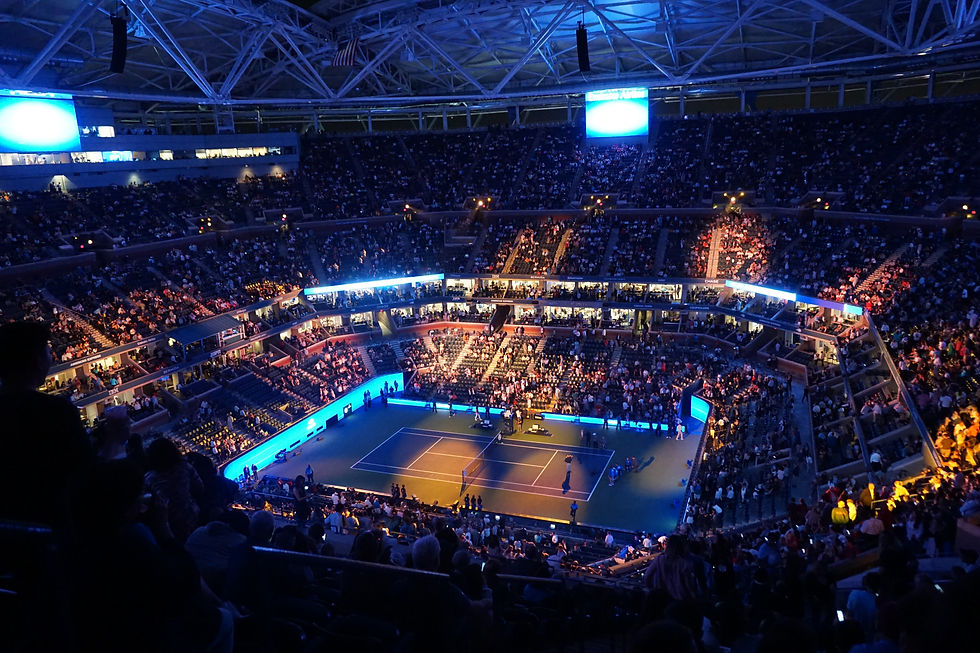
The USTA Billie Jean King National Tennis Center is located in Flushing Meadows–Corona Park in Queens, and the 2026 US Open runs from August 23 through September 13. Official US Open transportation guidance addresses event-specific parking, taxi, rideshare, and traffic movements around the venue, reinforcing that tournament access should be treated as a defined event environment rather than an ordinary Manhattan curbside arrival.
For the executive, however, the more important question is what happens to the social rhythm as the vehicle approaches the venue. A rushed arrival can force the host to shift suddenly from private conversation to wayfinding, ticket coordination, messages, and crowd navigation. A better approach clarifies the handoff in advance: who has the tickets, who is the point of contact, whether the full party is arriving together, and what the principal needs to know before the doors open.
The best arrival is one that requires very little executive cognition. The principal should not become the dispatcher simply because the venue is busy. This does not mean pretending that congestion, access rules, or pedestrian movement can be eliminated. It means separating what the executive must decide from what can be prepared beforehand. For an important client evening, that separation helps the host remain present with the guest instead of visibly managing logistics.
This distinction becomes more important when the evening follows an already demanding schedule. If the executive has moved from meetings directly into the US Open program, there is little benefit in creating an elaborate arrival ritual. What matters is clarity: the party knows what happens next, the designated coordinator knows whom to contact, and the principal is free to move naturally into the event.
That is a different standard from chasing the shortest theoretical arrival. A few minutes saved have limited value if the handoff itself creates confusion. For an executive evening, quality is better measured by continuity of attention than by the appearance of speed.

The Return Is an Energy Decision, Not Just a Pickup
Late in the evening, the executive’s decision quality and patience for minor friction are different from what they were at departure. The match may have been absorbing, the hospitality environment may have required sustained attention, and the group may have spent hours in conversation. The return therefore deserves its own service logic rather than being treated as the departure plan in reverse.
A useful return plan identifies the likely destination, the person authorized to communicate changes, and any plausible second stop before the evening begins. It should also consider whether the principal is likely to want conversation, privacy, a direct return to the hotel or residence, or continuity into a later dinner or private engagement. The closing movement should reduce choices at the moment when the executive is least interested in making them.
This is also where restraint matters. Over-coordination can be as intrusive as under-coordination. Senior executives generally do not need a stream of operational messages if one designated contact can manage the essential information. The concierge layer should become quieter as the evening progresses: clear when needed, invisible when not. The result is not theatrical service. It is a controlled conclusion in which the principal can leave the event without reopening the logistical work of the day.
The return can also serve a different social purpose from the outbound journey. The conversation before the US Open may be anticipatory, commercial, or guest-focused. Afterward, the principal may prefer a considerably quieter environment. Treating both movements identically ignores how executive energy changes across several hours.
That is why a sophisticated transportation brief should describe more than locations. It should communicate the expected character of the evening. Operational continuity does not mean behavioral uniformity. The same principal may need engagement on the way to Queens and privacy on the way back to Manhattan.
How to Reserve the Right US Open Evening Chauffeur Service
At the decision stage, executives and their assistants should evaluate more than availability and vehicle category. The service should be built from the evening backward: what state should the principal be in when arriving, what obligations exist after the match, who is joining, and how much flexibility is genuinely required. Those questions create a more useful brief than a request for “an SUV to the US Open.”
Before reserving, confirm the principal pickup point, session date, approximate departure window, passenger count, vehicle preference, guest joining points, expected final destination, and the person authorized to communicate adjustments. If an airport or private aviation arrival precedes the evening, that dependency should be disclosed as part of the same itinerary rather than treated as an unrelated transfer. The same applies to a dinner, reception, or hotel change afterward.
VIP NYC Transfers can then structure the private transportation proposal around the confirmed requirements, with all-inclusive pricing and a concierge communication layer appropriate to the evening. The decision standard is simple: reserve a service structure that protects executive attention across the whole night, not merely a vehicle that is available at the desired hour. For high-demand US Open dates, earlier coordination is prudent because preferred vehicle categories and extended service windows can become more limited as the tournament approaches.
The most useful reservation conversation is therefore concise but complete. An executive assistant or chief of staff should be able to communicate:
Where the principal is coming from before the evening.
Whether guests are joining before or at the event.
The level of privacy expected during the outbound journey.
The approximate post-event plan.
Any airport, private aviation, dinner, hotel, or residence dependency.
Who has authority to communicate changes during the service.
Once those elements are established, transportation becomes significantly easier to evaluate. The question is no longer whether a provider can supply a vehicle. The question is whether the operating structure corresponds to the evening the executive actually intends to have.
Comparison Matrix
Executive evening criterion | Basic event transfer | Individually booked segments | VIP NYC Transfers reference standard |
Business-day release | Begins at stated pickup time | Managed separately for each segment | Pickup planning considers the principal’s preceding obligations |
Reset interval | Incidental | May vary between providers or vehicles | Vehicle and guest structure considered in relation to privacy and executive needs |
Guest integration | Passenger count primarily determines setup | Guests may coordinate separate movements | Joining points and party composition can be incorporated into the confirmed itinerary |
Venue arrival | Transportation ends at arrival | Each segment handled independently | Arrival treated as part of the executive evening and coordinated around confirmed requirements |
Communication | Often principal- or passenger-led | Multiple contacts may become involved | Defined concierge communication path with the appropriate designated contact |
Post-event movement | Predetermined pickup | New segment may require separate coordination | Return structure considered when the evening is planned |
Executive attention required | Potentially significant when conditions change | Coordination remains fragmented | Objective is to reduce unnecessary operational attention once the service begins |
Best fit | Simple, fixed event movement | Unrelated point-to-point requirements | Executive evenings where continuity, discretion, and service design matter |

US Open Evening Chauffeur Service in NYC: The Executive Standard for a Complete Night
An exceptional US Open evening does not require spectacle around the transportation. It requires the opposite: a plan intelligent enough to become unobtrusive.
For executives, executive assistants, and chiefs of staff preparing an important evening at the US Open, VIP NYC Transfers can review the complete itinerary and structure chauffeur services around the principal’s departure, guest composition, preferred vehicle, privacy requirements, event attendance, and anticipated return.
To reserve chauffeur services, share the date, session, pickup point, passenger count, preferred vehicle profile, approximate service window, and any relevant commitments before or after the tournament. The concierge team can then prepare a private transportation proposal aligned with the confirmed requirements.
FAQ Section
What should an executive consider before reserving US Open evening chauffeur service?
The executive office should consider the principal’s obligations before the event, pickup location, passenger count, guest joining points, privacy requirements, approximate service window, intended destination afterward, and who will communicate any adjustments. The strongest plan reflects the complete evening rather than the stadium movement alone.
Is a point-to-point transfer sufficient for an executive attending an evening session?
It can be when the itinerary is simple, the party is traveling together, and both movements are reasonably defined. When the executive is hosting guests, coming directly from business obligations, continuing elsewhere afterward, or requiring greater flexibility, a broader chauffeur-service structure may be more appropriate.
Why does the transition from work matter when planning US Open transportation?
For a senior executive, the journey may be the only controlled interval between a demanding business day and several hours of social or client engagement. Protecting that interval can provide privacy, quiet, confidential conversation, or time to change pace before arrival.
Should an executive and invited clients travel to the US Open together?
Not necessarily. The decision should reflect the relationship, schedule, pickup locations, desired privacy, and purpose of the evening. In some cases, traveling together supports hospitality and conversation. In others, separate coordination preserves the principal’s private transition before meeting guests at the appropriate point.
What information should an executive assistant provide when reserving chauffeur services?
The assistant should provide the service date, session, principal pickup point, approximate departure timing, passenger count, vehicle preference, guest joining points, anticipated return destination, relevant pre- or post-event commitments, and the designated contact authorized to communicate adjustments.
How should the return from an evening US Open session be planned?
The return should consider the principal’s likely destination, possible secondary stop, communication contact, guest separation, and preference for privacy or continued conversation. The objective is to minimize unnecessary decisions at the end of a long evening.
When should US Open evening chauffeur service be reserved?
Coordination is best initiated once the attendance date, approximate itinerary, and passenger requirements are known. US Open dates create concentrated demand in New York, so earlier planning provides more opportunity to structure the service around the executive’s requirements rather than around remaining availability.
Can VIP NYC Transfers coordinate an airport or private aviation arrival before the US Open evening?
Yes, when those movements form part of the requested itinerary. VIP NYC Transfers serves major New York-area airports and private aviation movements, and the relevant arrival details should be shared during planning so the evening can be evaluated as one coordinated sequence rather than as unrelated segments.