
New York Fed Visitor Transportation: Two Entrances

New York Fed visitor transportation requires more than placing the headquarters address into a navigation system. Public institutional material identifies the Federal Reserve Bank of New York with 33 Liberty Street, yet the Bank's main-office directions instruct visitors to enter at 44 Maiden Lane; a separate school-group tour guide identifies 33 Liberty Street for that particular museum process. A building address, an entrance instruction and a lawful passenger-release location are three different things. Conflating them can create an avoidable delay for an executive with a fixed appointment.
For executive assistants, corporate hosts and visiting financial-sector professionals, the priority is to verify the invitation type, the current visitor entrance, identity requirements and who will release the guest for onward transportation. Chauffeur services may coordinate the external journey but do not determine the Bank's access policy or guarantee a vehicle can stop outside either entrance. The following framework uses the New York Fed's published guidance and deliberately distinguishes general directions from instructions for specific visitor programs.
New York Fed visitor transportation: identify the invitation before the entrance
Start with the invitation category, not the headquarters address. An invited executive meeting needs the named Bank host's current visitor instruction; a school-group education visit follows its booked program's separate written directions. A general building address does not determine which entrance is approved for the actual appointment, and neither entrance implies a lawful waiting position for a chauffeur. The coordinator should resolve the visit category and host authorization before issuing the vehicle's final approach instructions.
The inviting contact is the controlling source for an individual appointment. Ask for the precise entrance, check-in time, full visitor name as registered, acceptable identification, any restrictions on personal belongings and a telephone contact who can resolve changes. The Bank's general directions and group-visit FAQ should inform questions, not override current invitation instructions.
New York Fed entrance decision: 44 Maiden Lane or 33 Liberty Street?
The Bank's main-office visitor directions identify 44 Maiden Lane for general visitors and screening. Its school-group tour FAQ instead identifies 33 Liberty Street for booked school-group entry, with 44 Maiden Lane designated for wheelchair access in that school-tour context. The Bank also lists 33 Liberty Street as its headquarters mailing/address reference on its official contacts page. Therefore: invited executive or business meeting—follow the host's explicit admission instructions; booked school-group visit—follow the program's ticketed directions and accessibility exception; any differing invitation—verify directly with the Bank before finalizing arrival. None of these directions designates a lawful vehicle standing area.
The decision to send to the guest and chauffeur is a single verified pair: appointment category plus institution-confirmed entrance. Keep the street-level passenger release and later collection locations as separate transport instructions, subject to current law and conditions. Do not infer that 33 Liberty Street is wrong or that 44 Maiden Lane controls every program; the Bank's documents describe different visitor processes. If the invitation conflicts with a public website, stop and obtain confirmation from the inviting Bank contact rather than silently substituting an address.
A door for visitors is not automatically a vehicle position
Neither 44 Maiden Lane nor 33 Liberty Street should be treated as a standing allocation for a chauffeur. The Financial District contains constrained street segments, pedestrian activity, commercial loading demands and variable enforcement. A vehicle can approach only as lawfully permitted; the guest may have to walk from an approved nearby release point to the entrance and return to a different safe collection position on departure. For the wider district movement context, see our Financial District executive transportation planning.
When preparing the route, distinguish three labels: the official visitor entrance, the provisional guest drop-off, and the agreed collection point for the end of the appointment. They may differ. The assistant should obtain a concise pedestrian instruction that works for the actual traveler, especially where formal attire, luggage or mobility requirements affect the last stretch. No editorial article can certify a live curb condition; the transport coordinator must check current signage and local restrictions.
Security screening belongs to the institution
The Bank's public main-office directions say that visitors undergo screening and should be prepared to show an officially issued photo ID. They also state that photo-taking and recording devices cannot be used inside the building, and that public access can be restricted when heightened security requires it. Such conditions may affect arrival timing and what a visitor should bring, but they are not procedures the transportation provider may waive.
For an invited executive, ask the organizer whether the full legal name must match a registration record, whether a guest list has already been lodged and what identification is accepted for that specific purpose. If a companion or assistant will also enter, confirm that person's eligibility. The visitor should be prepared to follow directions from the institution's Security staff. External concierge transportation ends at the point where the building's admission authority begins.
Do not generalize the school group tour requirements
The New York Fed's school group FAQ gives precise instructions for ticket holders, including paper tickets and matching identification for adults, and advises school groups to arrive 30 minutes before the scheduled start on the printed ticket. These requirements are useful evidence for that program. They should not be copied into a business-meeting itinerary as if every Bank visitor receives the same printed ticket or follows the same entry workflow. For school-group visitors using wheelchairs, the Bank separately identifies 44 Maiden Lane as its wheelchair-accessible entrance. This is specific published school-visit guidance; meeting guests should confirm their own accessibility and arrival instructions with the host.
An assistant arranging a corporate discussion should confirm the business host's own process and treat educational-tour instructions as contextual rather than universally binding. Similarly, an educational group organizer should not assume an executive invitation confers access to the museum. The sensible check is direct: identify the visit category, verify the applicable official instructions and record any differences before the vehicle and guest depart.
Arriving from Midtown or another Manhattan meeting
The Bank's published directions orient visitors to the Financial District and identify transit links through Fulton Street and the surrounding streets. A vehicle itinerary requires additional attention because traffic approach, lawful release and a short walk are not the same as reaching an address pin. Planning should be based on the actual entrance specified for the visit, not a generic downtown landmark.
For an executive whose morning begins with a Midtown board discussion, the assistant should classify the first appointment's release time as variable, the Bank's check-in requirements as institution-controlled and the next obligation as fixed or negotiable. Communicate a range of plausible departure decisions to the coordinator, not an unsupported claim that Midtown-to-Wall-Street always takes a specific number of minutes. If a meeting runs late, the Bank host must decide whether admission remains feasible.
Arriving from a flight or private aviation movement
For a guest transferring from JFK, LaGuardia, Newark or a private aviation facility, airport readiness and Bank readiness must be coordinated separately. An estimated touchdown is not a passenger-ready time, particularly with checked baggage, customs or an international itinerary. A private aircraft can also be delayed by operational factors outside the chauffeur's control. A dispatcher should not convert a provisional flight schedule into an assured arrival at the Bank.
The assistant should include flight details only as necessary for operational planning, identify the fixed Bank admission window and make clear what happens if the guest cannot reasonably meet it. Where the institution cannot vary its check-in time, preserving a later onward appointment may be more valuable than forcing an impractical first stop. No transportation provider can guarantee expedited screening at a financial institution.
Plan confidentiality as an information-access problem
A central-bank meeting can involve commercially sensitive or personal circumstances. The transport record should include the guest identifier, authorized point of contact, approved locations and timing constraints without reproducing the purpose, confidential materials or names of unrelated participants. The host retains control of institutional guest information. The transport company needs enough information to coordinate a safe handoff, but no more.
For a principal traveling with an assistant, legal adviser or colleague, clarify which individuals are permitted into the building and which will continue elsewhere. A person who is not registered may have to wait outside. An assistant should never imply that accompanying a registered guest makes another person eligible for admission. Discretion is compatible with precise logistics: share the correct entrance and authorized contacts without distributing the meeting's substance.
Establish the visitor-ready signal for collection
A meeting at the Bank may end later than its calendar invitation indicates. Leaving a secure building, retrieving belongings and walking to a lawful pickup location can take additional time. Set one authorized contact to confirm when the guest has exited and is actually ready, rather than instructing the chauffeur to stand at a congested entrance at the listed end time.
The guest-facing instruction should be simple: leave by the authorized exit; advise the coordinator when outside; proceed to the preagreed legal collection point; and report any need for assistance. If the institution directs a different exit on the day, the guest should follow institutional instructions and the coordinator should then update the vehicle plan. Do not expect Security personnel to act as a valet or to manage private-vehicle staging.
Compare onward options instead of assuming a car is essential
An independent visitor whose next destination is accessible by transit may find a subway or pedestrian continuation entirely practical, especially in the dense Financial District. The Bank's official guidance details subway connections near Fulton Street. A car is not automatically the fastest or least complicated choice for a short downtown transfer, and it may add a roadside collection dependency that a self-directed traveler does not need.
Chauffeur services can become more appropriate when the principal has a multi-stop day, luggage, mobility needs, an airport connection, an accompanying party or confidentiality requirements that justify continuous coordination. The decision should be based on the entire itinerary: which segment is fixed, who controls each handoff, and how the guest will recover from delay. Operational reliability is more useful than blanket claims about comparative speed.
Who controls each New York Fed visitor decision
A secure Bank visit involves distinct decision owners. This matrix separates the institution's admission authority from the external transportation plan and the executive assistant's coordination responsibility. For a school tour or accessibility requirement, the current visit-specific Bank instructions still take precedence.
The Bank controls credentials, visitor entry and screening. VIP NYC Transfers coordinates only the external transportation arrangement; it has no authority to approve entrance or special curb access. The assistant reconciles instructions and the traveler signals actual departure readiness. The four responsibilities must meet without being conflated.
Decision owner | Responsible for | Cannot authorize | Essential handoff |
VIP NYC Transfers chauffeur services | Planned vehicle approach, lawful release and onward collection | Bank visitor credentials, admission or screening exemptions | Confirmed entrance from host; guest-ready signal and legal collection point |
New York Fed host and Security | Institutional visit instructions, entry point, registration and screening | Private-vehicle standing or collection rights on public streets | Confirm the admission process applicable to this specific visit |
Executive assistant or designated planner | One consistent itinerary, guest coordination and change decisions | Bank admission exceptions or unlawful curb access | Share the verified entrance and authorized transport instructions with all parties |
Visiting executive or guest | Identity documents, compliance with screening and readiness update | Immediate vehicle access to the Bank's entrance | Confirm actual exit and proceed to the agreed lawful collection location |
Distinguish a single executive from a coordinated delegation
A single principal with one appointment may need only an arrival briefing and a return collection confirmation. A group of executives can present a different problem: attendees arrive from multiple hotels, one visitor has a separate credential, and their release times differ. Do not rely on a single group booking label to resolve the distinct institutional registration conditions of individual guests.
For delegations, the assistant should keep a transport manifest that identifies each participant's authorized contact, proposed arrival sequence, vehicle allocation and onward destination. The institution should receive the relevant guest information through its own approved channel. Any changes to the attendance list must be authorized by the inviting office. If the group cannot be admitted together, avoid crowding a restricted entrance with an unplanned waiting arrangement.
What to do when an entrance instruction changes
Institutional security decisions can change without notice. The Bank's main-office guidance expressly allows for restrictions to public access. If the guest is directed to a different entrance, confirm it with the institution's designated contact and then issue one corrected set of instructions to the guest and transport coordinator. Neither a driver nor a public search snippet should decide how a visitor circumvents an active security direction.
A good contingency plan acknowledges that an appointment may be postponed or that a vehicle may need to use a different lawful collection point. The assistant should have an onward itinerary, an authorized decision-maker and a practical way to communicate changes discreetly. When a fixed meeting becomes impossible, state the constraint promptly rather than masking it with optimistic arrival assurances.
New York Fed exception protocol: when the invitation and public directions differ
Consider an illustrative executive appointment whose invitation gives an entrance that differs from the Bank's general 44 Maiden Lane visitor directions. Before departure, the assistant asks the named Bank host which door applies to this particular visit, which identification or registration steps govern it, and whether any accompanying person is separately authorized. The chauffeur receives only the confirmed entrance reference and a provisional lawful passenger-release instruction; the host—not the transport provider—decides the institutional access question.
If the guest is redirected by Bank Security on arrival, the guest should follow that instruction and immediately alert the authorized coordinator. The coordinator verifies the new institutional entry, updates the last pedestrian segment and revises the transport collection plan separately. For departure, obtain an actual outside-and-ready signal before directing a vehicle to an agreed lawful position. If screening or a changed exit affects the next appointment, notify its owner rather than promising that the vehicle or institutional Security can recover the lost time. No exception in this example is an actual event or an access privilege.
The New York Fed entrance-and-collection confirmation brief
A final New York Fed appointment brief needs a visit category; current Bank host and authority; institution-confirmed visitor entrance; guest names as registered where required; identity and screening instructions for that program; any school-only ticket or accessibility exception; a lawful vehicle release point distinct from the Bank doorway; a separate departure-ready contact; a viable onward destination; and an authorized owner for changed instructions. Mark an unconfirmed Bank entrance as a stop condition before dispatch, not an assumption to be fixed at the curb.
Recheck institutional directions shortly before the appointment. Official pages may be updated, and the event invitation can supersede general directions. For a coordinated executive itinerary, consult the VIP NYC Transfers executive transportation service and provide the concierge team with the minimum operational detail needed to assess an arrangement. Service confirmation depends on verified requirements and vehicle allocation.
Editorial responsibility and photograph license
Prepared by the VIP NYC Transfers editorial and concierge team for the 29 October 2026 production cycle. This is an independent transportation-planning guide, not guidance issued by the Federal Reserve Bank of New York and not evidence of a partnership, special visitor credential or security exception. For institution-controlled facts, refer to the New York Fed main-office directions, official contacts and school group tour FAQs.
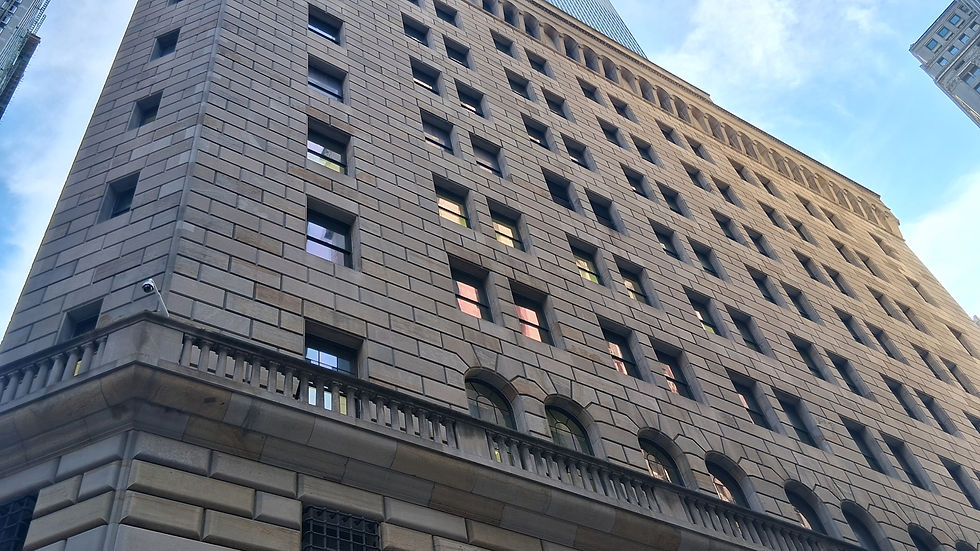
Photograph: Federal Reserve Bank of New York Building by Kidfly182, Wikimedia Commons, used under Creative Commons Attribution 4.0 without intentional modification. The photograph shows the historic headquarters building, not the verified visitor entrance for any particular appointment.
Frequently asked questions
Should an executive visitor use 33 Liberty Street or 44 Maiden Lane?
It depends on the visit. The Bank's main-office directions name 44 Maiden Lane for visitors, while its school group tour FAQ identifies 33 Liberty Street. Confirm the current entrance directly with the inviting host.
Can a chauffeur wait at the Bank's visitor entrance?
Do not assume so. An official building entrance is not a vehicle standing authorization. The coordinating team must confirm a lawful nearby collection position and communicate it to the traveler.
Does private transportation change New York Fed screening requirements?
No. Visitor identification, screening, admission restrictions and entry instructions are determined entirely by the Federal Reserve Bank of New York.
Do all visitors need printed museum tickets?
No universal rule should be inferred from the school group tour FAQ. Printed-ticket requirements described there apply to that visit program; a business host should confirm instructions for invited meetings.
What is essential in the executive itinerary?
The visit category, host name, verified visitor entrance, check-in instruction, legal passenger-release plan, return-ready contact and next destination.
Discuss a coordinated New York Fed arrival
For an executive appointment, contact VIP NYC Transfers with the verified Bank-host instructions, guest count, confirmed entrance and onward itinerary. Vehicle and chauffeur allocation is subject to verification and formal confirmation.


